


HINRICH FOUNDATION GUIDE to EMBAs
EMBA evaluation criteria
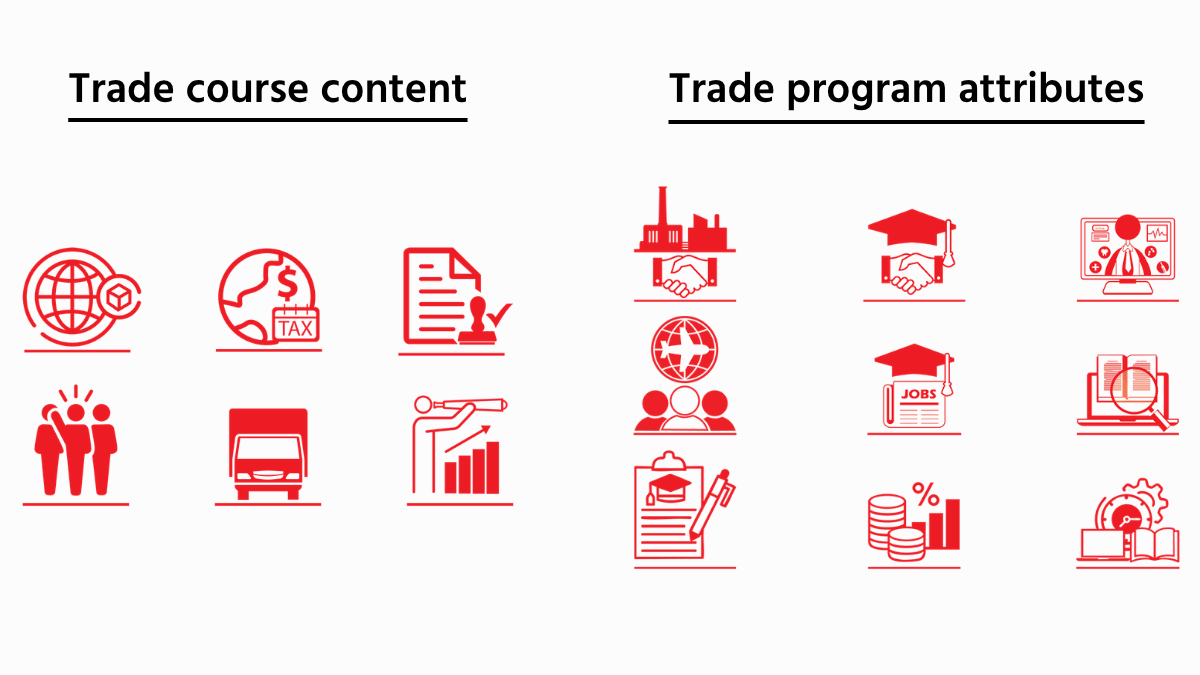
The Hinrich Foundation Guide to EMBAs in International Business and Trade is informed by rich insight from business executives and academics with expertise across global value chains. The EMBA program criteria encompasses six key trade course content areas and nine program attributes.
Page header - video
Building leadership in trade
Enter some text...
TRADE COURSE CONTENT
Before enrolling, executives should ensure that an EMBA program in international business and trade offers rigorous and future-ready trade content aligned with the competencies demanded of global trade leaders. The curriculum should prioritize in-depth understanding of:
- Cross-border trade business
- Cross-border trade policy
- Cross-border logistics & supply chain management
- Cross-border trade financial management
- Cross-border leadership & soft skills
- Evolving skills for global trade
- Cross-border trade business
- Cross-border trade policy
- Cross-border logistics & supply chain management
- Cross-border trade financial management
- Cross-border leadership & soft skills
- Evolving skills for global trade

Cross-border trade business

A deep understanding of cross-border trade dynamics is essential to global business leadership. Courses in this area build strategic insight into how to expand and sustain international operations through:
- Creative market entry strategies and international expansion models
- Business model innovation in consideration of geopolitical and economic shifts
- Sustainable and ethical practices aligned with profitability and corporate purpose
- Strategic procurement and negotiation for value creation and stakeholder alignment
- International and localized marketing, brand positioning and analytics across markets and platforms
- Trade in services, including cross-border delivery of financial, professional, digital and knowledge-based services
- Within-border and local business dynamics that underpin global trade value chains
Mastery of these fundamentals enable senior leaders to guide their organizations decisively through the complexity of global commerce.

Cross-border trade policy
Effective executives navigate and influence the global policy landscape shaping trade. Courses in this area should strengthen understanding of:
- Major agreements and frameworks such as WTO, USMCA, RCEP and CPTPP
- The intersection of geopolitics, domestic populations, politics and policies, business strategy and trade systems
- Corporate diplomacy and non-market strategies
- Regulatory dynamics – tariffs, non-tariff barriers, sanctions and protectionism
- Macroeconomic levers, including exchange rates and comparative advantage
- The role of trade in development, sustainability and inclusive growth
- Risk anticipation and scenario planning against plausible policy disruptions, achieved through simulations and stress-testing exercises
This knowledge empowers leaders to anticipate policy shifts, manage risk and shape strategic responses across multiple jurisdictions.

Cross-border logistics & supply chain management
Resilient supply chains underpin successful global businesses. Courses in this area refine executives’ ability to design and lead efficient, adaptive value chains, covering:
- Global supply chain architecture, planning and optimization
- Transportation, freight forwarding and multimodal logistics
- Big data, forecasting and visualization for operational agility
- Global manufacturing management, localization and quality assurance
- Sustainability, circular supply chains and responsible sourcing
- Incoterms, documentation and compliance frameworks including Country of Origin considerations
Equipped with these insights, executives can ensure supply chain resilience and integrity as strategic assets.

Cross-border trade financial management
Executives driving global operations must command the financial and legal dimensions of cross-border business. Core course components should include:
- Import-export finance instruments, risk mitigation and insurance structures
- International accounting, transfer pricing and global tax compliance
- ESG-driven governance and financial reporting standards
- Customs regimes, valuation and trade remedies
- International trade law, arbitration and IP rights
- Working capital optimization and cross-border performance management
Armed with this expertise, leaders can steward financial health and compliance across global subsidiaries and partnerships.

Cross-border leadership & soft skills
Guiding multinational organizations or divisions requires adaptive, people centered leadership. Courses should build reflective and interpersonal capacities such as:
- Communication across contexts
- Influence, persuasion and stakeholder management
- Organizational architecture and strategic resource deployment
- Decision-making under uncertainty, including learning agility, risk tolerance and the ability to act decisively with incomplete information
- Executive self-assessment and leadership diagnostics • Managing change across volatility and transformation
- Cross-cultural leadership and communications, and ethical decision-making
- Virtual team leadership and collaboration across time zones
- Critical thinking and strategic foresight
- Global talent management, mentoring, coaching and succession planning
- Board readiness, including understanding boardroom dynamics, obligations and managing board expectations
Such competencies prepare senior executives to lead high-performing international teams, drive organizational agility and establish sustained leadership impact.

Evolving skills for cross-border trade
To remain competitive, executives must lead digital transformation across their organizations and value chains. Courses should build strategic awareness and the confidence to drive adoption of evolving technologies, including:
- Artificial intelligence and automation for business management and trade analytics
- Internet of Things and sensor technologies for logistics optimization
- Data science and visualization for insight-driven decision-making
- Cloud computing and cybersecurity governance
- Blockchain applications for transparency and supply chain trust
- Developing fluency in these technologies allows leaders to future-proof their organizations and capitalize on emerging opportunities in digital trade.
Beyond familiarity with specific tools, executives must cultivate the learning agility and intellectual curiosity to continuously adapt as technology evolves. Executives should also foster organizational cultures where innovation, experimentation and digital fluency are actively encouraged and rewarded.




TRADE PROGRAM ATTRIBUTES
Prospective students should confirm that EMBA programs demonstrate excellence across nine core trade program attributes to develop the skills, knowledge and networks for sustained career success. These attributes are:
- Industry aligned curriculum & engagement
- Practitioner professors
- Career services
- Alumni support & network
- International exposure
- Leading research
- Program design & delivery
- Admissions & selection criteria
- Return on investment & career progression
- Industry aligned curriculum & engagement
- Practitioner professors
- Career services
- Alumni support & network
- International exposure
- Leading research
- Program design & delivery
- Admissions & selection criteria
- Return on investment & career progression
Ensuring your program embodies these attributes will equip you with the practical expertise, global perspective and support systems needed to sharpen your leadership and position your organization to navigate uncertainty and volatility.

Industry aligned curriculum & engagement
Executive programs in global trade must prioritize strong industry engagement so that the curriculum and learning environment integrate cutting-edge academic thinking with real-world senior-level practice. This is achieved through:
- Corporate partnerships that support academic programs and events, creating “living case studies” drawn from active collaborations between universities and businesses
- Learning from guest speakers from companies and trade organizations, giving executives direct visibility into current boardroom challenges and emerging global trade trends
- Collaborative research projects that enable participants to co-develop innovative solutions across global trade value chains and apply them within their own organizations
- Working with cohorts and professors to provide strategic advisory input on real industry challenges, mirroring high-stakes consulting and board engagements
- In-company projects that allow you to test and implement new concepts in your day-to-day operations, driving immediate organizational impact and gaining greater access and exposure to senior leadership
When selecting your EMBA program in trade, confirm that it embeds strong industry engagement initiatives. This will ensure that you are well-equipped to thrive in the ever-changing complex world of international commerce.

Practitioner professors
Professors with current real-world experience in global trade bring boardroom-level insights and practical expertise that significantly elevate learning outcomes for executives. Benefits include:
- Real world insights into international trade practices, regulatory shifts, operational challenges and emerging trends, grounded in years of non-academic, front-line trade leadership
- Learning that is highly relatable and practical, as professors draw on actual cases and specialized knowledge directly relevant to global business decision-making
- Opportunities for guest lectures, collaborations and potential mandates through their professional networks with multinationals, financial institutions and trade bodies
- Mentorship and career guidance from seasoned practitioners who understand how to help executives de-risk, reposition and “shockproof” their businesses
Confirm that your program is taught predominantly by practitioner professors, particularly those who actively consult for multinational corporations and provide strategic or board-level advisory. This blend of scholarship and practice equips you with the insights, tools and networks required to lead in the fast-changing global trade arena.

Career services
When selecting your EMBA program, ensure it offers robust, executive-oriented career services throughout the program and beyond. This is essential for expanding senior-level mobility over time and access to high-profile opportunities.
Executive coaching
One-on-one coaching to surface leadership blind spots, clarify your value proposition and support key career transitions, including role elevation, sector shifts and board readiness
Connectivity
Direct and broad access to retained search firms and senior recruiters handling C-suite and regional leadership mandates
Mentorship programs
Structured pairing with senior industry professionals for personalized career insights, strategic advice and potential sponsorship
Career advising
Guidance on positioning your profile, refining your narrative, and tailoring resumes, interviews and job search strategies to senior roles in international trade and related fields
Senior managers seek programs that help them refine their leadership identity and market positioning, not just their technical skills. Tailored career services provide a structured pathway to new opportunities and accelerated leadership progression.

Alumni support & network
A high-quality EMBA is reflected in the leadership success of its graduates and the reach and influence of its alumni network. When evaluating programs, look for:
Alumni network
A vibrant, globally distributed alumni community, actively supported by the university, that creates sustained peer to peer opportunities for business, investment, collaboration and thought leadership
Proactive alumni engagement programs
Dedicated alumni services such as mentorship schemes, engagement complimentary or discounted annual modules, and programs curated networking events that enable continuous professional development and reconnection at senior levels
Ongoing career support
Access to job placement assistance, curated industry support insights, leadership programs and exclusive opportunities tailored to experienced professionals navigating senior-level moves
Alumni leadership advancement
Graduates who progress into C-suite, regional head or advancement board roles, signaling the program’s ability to prepare executives for high-impact global trade positions
The cohesion, visibility and success of the alumni community – combined with proactive institutional support – strongly signal the quality of the curriculum, faculty and industry engagement, as well as the program’s commitment to long-term career outcomes.

International exposure
A global trade EMBA program should offer a genuinely international cohort and meaningful overseas learning experiences and a diverse, international faculty as core elements of the design. Key benefits include:
- Exposure to diverse cultural perspectives that deepen global mindset, adaptability and executive self-awareness
- Preparation for leading teams, functions and business units spread across markets, regions and cultures
- Opportunities to build broad, cross-border professional networks that can support deals, partnerships and future career moves
- Development of inclusivity and cross-cultural leadership capabilities essential for operating in complex geopolitical and market environments
- Structured institutional access to businesses, governments and trade promotion agencies, opening doors to new markets and policy insights
- Space to reflect on mindful, inclusive and ethical leadership in varied cultural and socioeconomic contexts
Choosing a program with a well-rounded, diverse student body and serious international immersion experiences and an internationally diverse faculty strengthens your ability to operate as a truly global executive in trade.

Leading research
The quality and influence of an institution’s research signal its capacity to shape advanced thinking in global trade and inform senior-level practice. When choosing graduate programs, prospective students should review faculty publication output and citation impact – specifically in international business and trade.
Highly-cited research in areas such as trade policy, logistics, finance, sustainability and technology in respected journals demonstrates faculty thought leadership and foresight, which typically translate into forward-looking teaching and case material. Importantly, faculty that produce research that reaches beyond academic walls, informing policy decisions, contributing to public discourse and shaping thinking in business and government.
A strong research culture attracts top scholars and practitioners, fostering a dynamic intellectual community. Executives gain opportunities to collaborate on research projects, co-author papers or practitioner reports, and deepen analytical and evidence-based decision-making capabilities.

Program design & delivery
Executives look for programs that shift from rigid, classroom-only structures to flexible formats that respect senior work schedules while maintaining rigor. Executive programs may adopt the following approaches:
Residency blocks: One week of intensive, in-person study every two to three months, enabling deep immersion with minimal disruption to executive responsibilities
Weekend intensives: Up to three days of teaching per week, providing steady progress while allowing you to balance regional travel, team leadership and family commitments
Blended / hybrid: A combination of online and in-person learning, learning leveraging high quality digital platforms to support preparation, simulations and ongoing collaboration
Senior managers and director-level candidates care deeply about program delivery, as it directly affects work planning and stakeholder expectations. A predictable long-range schedule and clear participation requirements are essential.
Equally, robust learning platforms and tools are expected. Executives look for seamless digital portals, on-demand access to materials and data, and preparatory modules that help them recalibrate study habits after years in the workforce.
Leading EMBA programs must Incorporate experiential learning methodologies, including simulations, scenario exercises and stress-testing, that place executives in realistic, high-stakes situations to sharpen judgment, decision-making and leadership under pressure.

Admissions & selection criteria
Admissions and selection criteria are a critical attribute of leading EMBAs. They shape cohort quality, the depth of classroom dialogue and the long-term brand and signaling value of the degree.
Strong, transparent criteria demonstrate a deliberate focus on curating experienced, high-caliber executives who can manage academic rigor and contribute meaningfully to peer learning. For candidates, understanding these standards helps assess whether the cohort’s experience level and ambitions align with their own leadership trajectory.
Typical criteria include years of work and managerial experience, evidence of career progression and increasing responsibility, strength of professional profile and academic readiness. A carefully curated cohort creates a powerful, peer- driven learning environment and network.

Return on investment & career progression
Undertaking an executive program is a significant financial, time and reputational commitment. EMBA candidates expect the program to deliver clear, strategic career returns, including:
Salary uplift: A meaningful increase in total compensation within three to five years of graduation, reflecting enhanced responsibilities and market positioning
Payback period: An acceptable payback timeframe, typically two to four years, when considering tuition, opportunity cost and ancillary expenses
Promotions and role expansion: Clear evidence that graduates move into higher-level roles, assume greater P&L accountability, or expand into regional or global mandates
Career switch and options: A material proportion of graduates successfully changing industry, function or geography, or transitioning into entrepreneurial, portfolio or advisory careers previously out of reach
A strong return on investment ensures that an EMBA program becomes a strategic asset for mid-career professionals and senior managers, justifying the disruption to work and personal commitments, and supporting long-term career resilience and mobility.

Industry aligned curriculum & engagement


Cost & financial aid
⌃




In addition to the Hinrich Foundation Guide criteria above, we acknowledge that there are other factors that each individual must take into consideration when evaluating and selecting an EMBA in international business and trade. We trust the Hinrich Foundation Guide EMBA criteria will help you find the quality program that helps you to achieve your career objectives.

